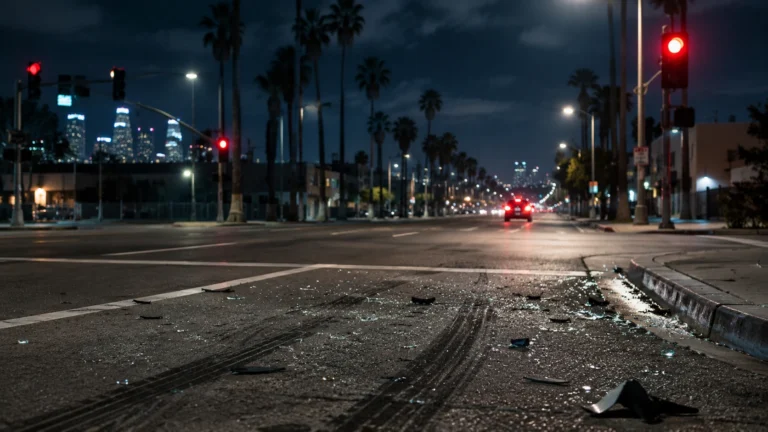
If you drive in Los Angeles, you already have a mental map. The intersection where someone always blows the red. The left turn that backs up into the lane next to you. The cross street where pedestrians appear out of nowhere. Most LA drivers learn these spots through near-misses or actual crashes.
That instinct is backed by data. Los Angeles tracks collisions through several public systems, and a small slice of city streets accounts for most of the worst accidents. Knowing where they cluster helps you drive defensively. If you have already been hit at one of these spots, the same data can support your insurance claim.
How Los Angeles Tracks Crash Hotspots
LA pulls crash data from three main sources.
The first is the Statewide Integrated Traffic Records System, known as SWITRS. Every police agency in California submits crash reports to this database. The University of California, Berkeley runs a public tool called TIMS that lets anyone map SWITRS data by location, year, crash type, and severity.
The second is LA Vision Zero. This is the city’s traffic safety program. Vision Zero publishes the High Injury Network, a map of streets where most severe and fatal crashes happen. About 6 percent of LA streets account for the majority of the city’s serious injuries and deaths. That 6 percent is the network.
The third is LADOT’s own crash dashboards. These give a public view of where collisions cluster month over month. Combined with LAPD reports and neighborhood council data, they paint a clear picture of LA’s danger zones.
What Makes an Intersection Dangerous
A few patterns show up across LA’s worst intersections.
Mixed-use traffic. Streets where drivers, cyclists, pedestrians, scooters, buses, and delivery trucks all share space produce more crashes. More conflict points mean more collisions.
Poor signal timing. Some intersections have yellow lights that flash for under three seconds. Some have leading pedestrian intervals drivers ignore. Bad timing creates predictable mistakes.
Wide arterials with high speeds. A six-lane road through a dense neighborhood gives drivers room to run 50 mph in a 35 zone. When pedestrians try to cross, the outcome is rarely good.
Limited visibility. Hills, curves, parked vehicles, and overgrown landscaping create blind spots. Drivers cannot see what is coming. Pedestrians cannot see drivers.
High left-turn volumes without protected phases. Unprotected left turns across multiple lanes of oncoming traffic produce a steady flow of T-bone collisions.
LA’s Best-Known Problem Corridors
Vision Zero’s High Injury Network includes long sections of these streets:
- Vermont Avenue through Koreatown and South LA
- Western Avenue along its full length
- Sunset Boulevard through Hollywood and Echo Park
- Wilshire Boulevard from DTLA to the coast
- Pico Boulevard and Olympic Boulevard as east-west arterials
- Sepulveda Boulevard through parts of the Valley and Westside
- Lankershim Boulevard in North Hollywood
- Roscoe Boulevard in the San Fernando Valley
- Figueroa Street through DTLA and South LA
The specific intersections inside these corridors shift year to year. The corridors themselves stay on the network because they share structural problems that the city has not addressed.
Why This Data Matters for Your Case
If you were hit at an intersection that already shows up on LA’s High Injury Network, that history can support your insurance claim. The argument goes like this: the city knew this intersection was dangerous, the design contributed to the crash, and the other driver’s mistake was a predictable outcome of that design. None of that excuses the at-fault driver, but it can push back hard against any attempt to assign you partial fault.
In a smaller number of cases, the public entity itself may share legal responsibility. California Government Code section 835 allows recovery against public bodies when public property is in a dangerous condition, the entity knew or should have known about it, and that condition caused the harm. Claims against public entities have stricter deadlines (a government claim form usually must be filed within six months under Government Code 911.2) and a higher burden of proof. Most accident victims will not pursue this route, but it is worth knowing it exists.
The more common benefit of intersection data is keeping insurance companies honest. California uses pure comparative fault, so any percentage of fault assigned to you reduces your recovery. If the adjuster tries to argue you “should have been more careful,” strong evidence about the intersection’s history makes that argument harder to sustain. Our car accident lawyer page walks through how fault percentages affect your settlement in more detail.
What to Do If You Are in a Crash at One of These Spots
Five steps make a real difference.
Photograph everything. Take pictures of the intersection from every angle you can manage safely. Capture the lane markings, the signage, the signal positions, and the sight lines. These images become evidence later.
Note the time and conditions. Many dangerous intersections are worst at specific hours: school dismissal, rush hour, late-night bar traffic. Your record of conditions strengthens the file.
Request the police report. California Vehicle Code 20012 lets anyone involved in a crash request the official report for a fee. Get yours.
Pull intersection history if needed. Public records requests can sometimes produce signal timing changes, prior complaints, and maintenance logs. This is a step you would usually take with a lawyer.
Get medical care, even if you feel okay. Adrenaline hides injury. Many serious back, neck, and head injuries do not present for hours or days. Get checked out the same day.
When to Bring a Lawyer Into the Picture
Most LA intersection crashes are decided by insurance negotiation, not litigation. The question is usually not “who was at fault” (often clear) but “what is the case worth” (always disputed). When the insurance company offers less than your medical bills, less than your lost wages, and nothing for the months of pain you have actually lived through, that is when a lawyer changes the math.
Crashes at known-dangerous intersections sometimes carry extra complexity. Multiple defendants, possible public entity claims, conflicting witness accounts, or design defects can all change what the case is worth. Sorting through that is what experienced personal injury attorneys do.
At Ask Hamlet, our team handles car accident cases across Los Angeles, including crashes at the corridors on the city’s High Injury Network. Pulling the data, building the file, and countering insurance company attempts to blame the victim is what we do every day.
If you have been hit and you are not sure what your case is actually worth, contact us for a free case review. You pay nothing unless we win.