After an Arroyo Seco Parkway accident, fault goes to the driver who broke a rule of the road. On the ramps, that is often the driver who merged before it was safe.
The driver already on the parkway can share the blame, for speeding or for following too close.
Why is the Arroyo Seco Parkway hard to merge onto?
It was built for the cars of 1940. The National Park Service calls it the first freeway in the West, and says its ramps are short by modern standards.
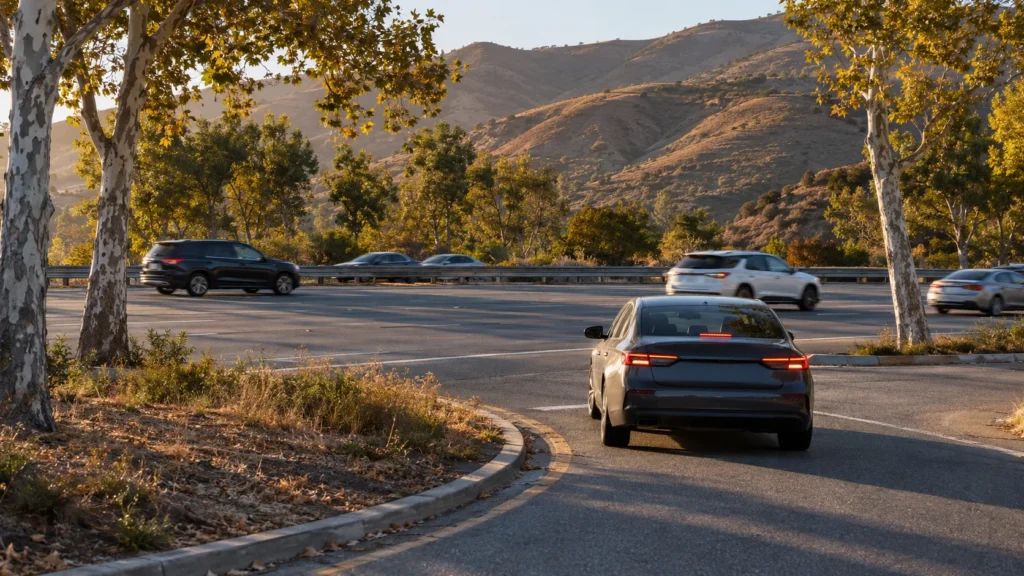
The Los Angeles newsroom LAist describes the ramps near Highland Park as short, with blind curves. It reports a stop sign at the Avenue 52 ramp, where a driver joins fast traffic from a standstill.
Who has to yield at the end of the ramp?
The driver on the ramp does. Vehicle Code section 22450 requires a stop at a stop sign. Section 21802 then tells that driver to yield to any car close enough to be a hazard.
A ramp with no stop sign follows the same idea. Under section 22107, no driver may move left or right on a road until the move is safe.
Can the driver already on the parkway be at fault?
Yes. Section 22350, the basic speed law, bans any speed that is not reasonable for the traffic, the visibility and the width of the road.
So a driver at the posted limit can be too fast for a blind curve. Section 21703 also bans following another car more closely than is reasonable.
Under section 21658, a driver may not leave a lane until that move is safe. That covers a swerve into the next lane to get around a merging car.
What if you were the driver who merged?
You can have a claim too. The duty to yield does not excuse a parkway driver who was speeding, or who changed lanes into your car.
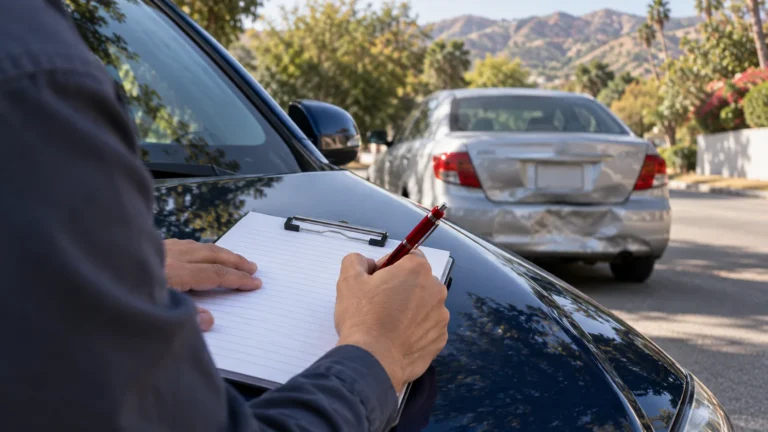
Write down what you saw before you pulled out. Note how far away the other car was, and which lane it was in.
What if both drivers made a mistake?
Then they share the fault. In California, being partly to blame reduces a claim by that driver’s share. It does not end the claim.
We explain how the shares are worked out in our article on California’s pure comparative fault rule.
Should you move your car off the parkway?
If nobody is hurt, yes. Vehicle Code section 20002 tells a driver in a damage only crash to stop at the nearest place that does not block traffic.
The same section says that moving the car does not affect the question of fault. When someone is hurt, section 20001 requires each driver to stop at the scene.
Who writes the police report?
The California Highway Patrol does. Its Southern Division lists State Route 110, the Arroyo Seco, among the freeways it covers.
A crash on Figueroa Street or York Boulevard is an LAPD report. Tell the officer which ramp you used and where the two cars touched, and ask for the report number.
What evidence helps after a ramp crash?
Fault on a ramp depends on where each car was and how fast it moved. Collect what shows both.
- Photos of both cars and the damage on each one.
- A photo looking back down the ramp, to show how far a driver could see.
- Dash camera video from your car, or from a driver who stopped.
- The names and phone numbers of witnesses.
- The name of the ramp and the direction you were going.
Take photos only from a safe place. Do not stand in a traffic lane.
How this plays out in Highland Park
Highland Park drivers reach the parkway from ramps such as Avenue 52, Via Marisol and Avenue 60. Figueroa Street, the main street of the neighborhood, is parallel to much of it.
The parkway is a state highway. A claim that blames the road itself is a claim against a public agency, and Government Code section 911.2 gives six months to present it.
Our office is one neighborhood over, on North Eagle Rock Boulevard.
What to do after a crash on the parkway
- Call 911 if anyone is hurt.
- If nobody is hurt and the cars can drive, pull off at the nearest safe place.
- Trade names, license numbers and insurance details with the other driver.
- Photograph both cars and the ramp.
- Ask the CHP officer for the report number.
- Get checked by a doctor the same day.
Ask who had to yield
We can read the CHP report against your photos and tell you how the rules above apply to your crash. If the fault looks shared, you will hear that from us as well.
There is no fee to ask, and no fee unless we win. Here is how we work as a car accident lawyer in Highland Park, and how to reach our team in English, Spanish or Armenian.