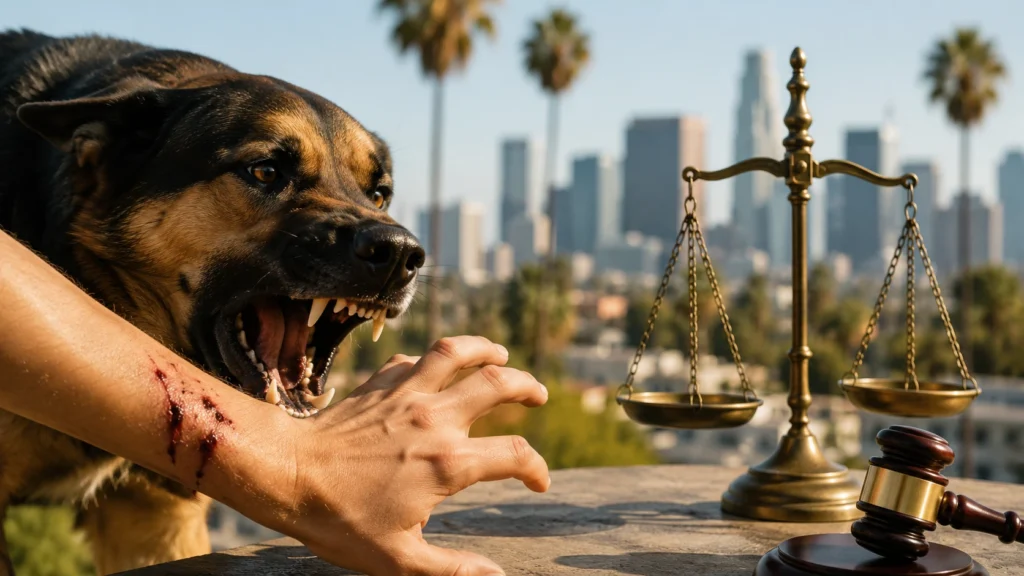
Dog bites cause more than 800,000 medical visits in the United States every year. In Los Angeles, they are a common cause of emergency room visits and personal injury claims. What makes California particularly favorable for dog bite victims is a statute that most people have never heard of: Civil Code 3342.
The law makes California what is called a “strict liability” state for dog bites. Unlike states that use the “one bite” rule (which requires proving the owner knew the dog was dangerous), California holds owners responsible from the very first incident, with only a handful of narrow defenses available. This article walks through what that means in practice.
The Statute Itself
California Civil Code section 3342 reads, in relevant part:
The owner of any dog is liable for the damages suffered by any person who is bitten by the dog while in a public place or lawfully in a private place, including the property of the owner of the dog, regardless of the former viciousness of the dog or the owner’s knowledge of such viciousness.
That single sentence does a lot of work. It removes the traditional common-law requirement that a dog bite victim prove the owner knew the dog was dangerous. It applies to bites in public places and to bites at the owner’s own home when the victim was lawfully present. It applies from the first bite forward, with no free pass for previously well-behaved dogs.
Strict Liability vs the “One Bite” Rule
Most states use some version of the “one bite” rule. Under that system, an owner is not liable for a dog’s first bite unless the victim can prove the owner knew or should have known the dog was dangerous. Some states require actual prior bites. Others require proof of aggressive behavior. Either way, the burden falls on the victim.
California rejected this approach in favor of strict liability. Under Civil Code 3342, the victim does not have to prove:
- That the dog had bitten before
- That the owner knew the dog was aggressive
- That the owner was negligent in handling the dog
- That the owner should have anticipated the bite
The victim only has to prove that the bite happened, that they were lawfully present, and that they suffered damages. The rest is presumed.
This is one of the friendliest dog bite frameworks for victims in the country.
What Counts as a “Bite”
The statute uses the word “bite” specifically. California courts have interpreted this to mean actual biting, not other dog-caused injuries. A dog knocking someone over, scratching them, or causing them to fall while running is not a “bite” under 3342.
For injuries caused by dogs but not involving biting, victims can still pursue negligence claims under general California law. These claims require proof of owner negligence, which is more difficult but not impossible.
The Defenses That Do Exist
Strict liability is not absolute. California recognizes a few narrow defenses:
Trespassing. The statute only protects victims who were “lawfully in a private place.” Someone trespassing at the time of the bite generally cannot recover under 3342. What counts as trespassing has been narrowed by courts over the years, and delivery drivers, mail carriers, and children innocently entering property are generally not treated as trespassers.
Provocation. If the victim provoked the dog, the defense of comparative fault can reduce or bar recovery. Comparative fault does not fully eliminate the claim (California’s pure comparative fault rule applies), but it can reduce damages. Provocation requires actual provocation, not incidental contact.
Police and military dogs. Government-owned dogs used in law enforcement or military service are exempt from 3342 under Civil Code section 3342(b), provided the dog was acting within the scope of its duties and reasonable training was in place.
Veterinarian’s rule. Veterinarians and their staff have limited ability to recover for bites that occur during the course of their work under a specific application of the assumption of risk doctrine.
Outside these narrow categories, the defenses available to dog owners are limited.
LA County and City Ordinances
Beyond the state statute, LA County and the City of Los Angeles have local ordinances that add layers to dog bite cases.
LA County Code Title 10. Governs animal control across unincorporated county areas. Includes provisions for dangerous dog declarations, mandatory quarantine after bites, and animal control investigation procedures.
LA Municipal Code Chapter 5. Governs animals within the City of LA. Similar structure with local enforcement variations.
Leash laws. Both LA County and the City of LA require dogs to be leashed in public places (with limited exceptions like designated off-leash areas). Violation of a leash law can support a negligence per se argument in a dog bite case, adding to the strict liability claim.
Dangerous dog hearings. After a serious bite, animal control may declare the dog “potentially dangerous” or “vicious.” These declarations trigger additional owner obligations (secure enclosures, insurance requirements, signage) and can support later civil claims.
Homeowners Insurance and Dog Bite Claims
Most dog bite claims are paid by the owner’s homeowners or renters insurance policy. Standard homeowners policies include liability coverage that applies to injuries the insured causes to others, including dog bites.
The catch: many policies now exclude certain breeds. Pit bulls, Rottweilers, German Shepherds, and other breeds are sometimes excluded from coverage. When the dog’s breed is on the exclusion list, the owner may be personally liable for damages, which can create collection problems.
Statute of Limitations
Under California Code of Civil Procedure section 335.1, personal injury claims (including dog bite claims) must be filed within two years of the date of the incident. Claims involving minors have different timing rules under Code of Civil Procedure section 352.
Cases Involving Children
Dog bites involving children require special attention.
No comparative fault for children under five. California courts have generally held that children under five cannot be assigned comparative fault for provocation.
Enhanced damages. Children who suffer permanent scarring, facial injury, or psychological trauma often recover larger amounts than adults with similar injuries.
Delayed statute of limitations. For minors, the two-year clock typically does not start running until the child turns 18. This is why dog bite cases involving young children sometimes proceed years after the incident.
Different treatment protocols. Pediatric injuries from dog bites often require plastic surgery, mental health treatment, and long-term follow-up. Damages projections need to account for this.
What to Do After a Dog Bite
Six practical steps:
Get medical care. Dog bites carry infection risk. Even minor-looking bites need medical evaluation.
Photograph the injury. Multiple times over multiple days as bruising develops and fades.
Report to LA County or LA City Animal Control. This creates an official record and triggers the quarantine and investigation process.
Get the owner’s information. Name, address, phone, homeowners insurance carrier if you can obtain it.
Identify the dog. Breed, name, physical description. This matters for the insurance and animal control process.
Contact a personal injury attorney. Dog bite cases have specific procedural requirements and dedicated statutory framework. A dog bite attorney can help with both the civil claim and the animal control process.
Why California’s Framework Favors Victims
For victims, California’s strict liability rule matters practically:
- No need to prove the dog had bitten before
- No need to prove the owner was negligent
- No need to establish the owner’s knowledge of the dog’s temperament
- Straightforward path to homeowners insurance recovery
- Clear framework for prosecuting the claim
The framework is not automatic. Even with strict liability, insurance companies contest damages, dispute the injury severity, and sometimes fight the “lawful presence” element. The statute provides a strong starting point, but the case still needs to be built.
At Ask Hamlet, our personal injury practice handles dog bite cases regularly. Our team has worked cases against most of the major California homeowners insurance carriers. The animal control investigation and the civil case run on parallel tracks, and we manage both.
If you or a family member has been bitten by a dog in Los Angeles, contact us for a free case review. There is no obligation. We do not charge unless we win.