An Uber driver runs a red light and hits your car. The damage is serious. You have never been in a rideshare crash before, and it is not immediately clear how the insurance works. Is the driver’s personal auto policy going to pay? Is Uber’s policy going to pay? Is the app relevant to any of this?
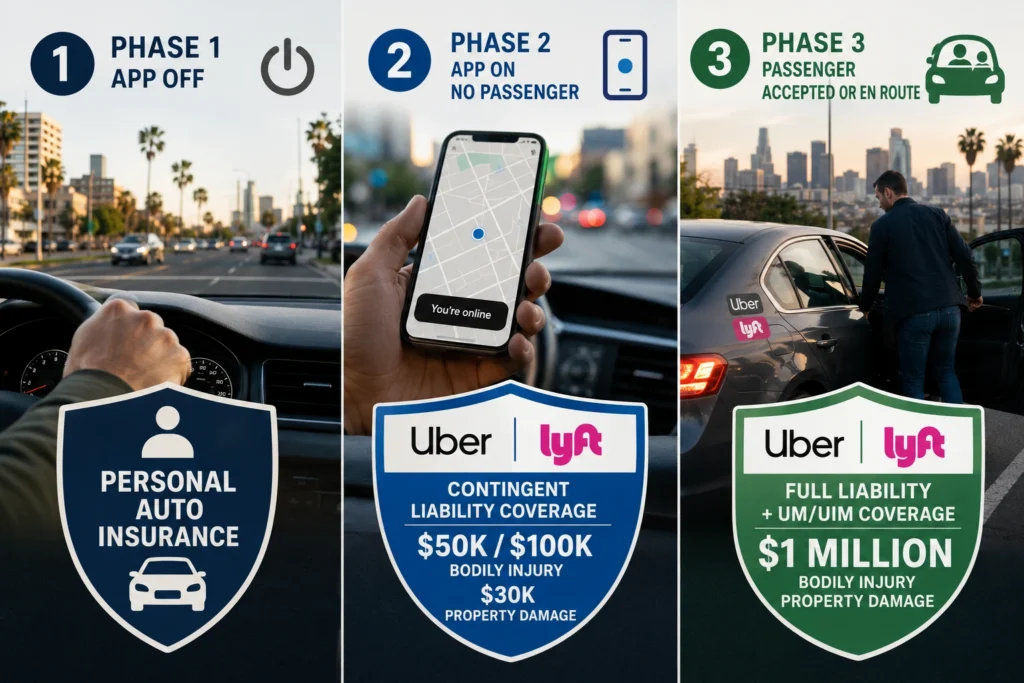
The short answer is that California rideshare insurance is built around three phases of driver activity. Which phase the driver was in at the moment of the crash determines which insurance policy applies and how much coverage is available. This article walks through the three phases and how they play out in practice.
The California Framework
California regulates rideshare insurance under Public Utilities Code sections 5430 through 5443, plus regulations from the California Public Utilities Commission (CPUC). The framework was created after years of debate about whether rideshare drivers were commercial drivers, personal drivers, or something in between.
The legislature landed on a phased system. Drivers are treated differently at different points in their work cycle. Insurance coverage steps up as the driver moves closer to actively providing a ride.
Phase One: App Off (Driver Not Working)
When it applies: The driver has the app closed. They are just driving as a private citizen.
Coverage: Only the driver’s personal auto insurance policy applies. Uber and Lyft have no involvement.
Phase one crashes are treated exactly like any other private-vehicle crash. If you were hit by an Uber or Lyft driver during phase one, your claim goes against the driver’s personal insurance. The rideshare company has no obligation.
The catch: many personal auto policies exclude coverage for drivers who are also active on rideshare platforms. This gap has caused problems for both riders and the third parties they hit. In California, rideshare drivers are supposed to have coverage that extends to their personal driving as well, but disputes still arise.
Phase Two: App On, No Passenger Assigned (Driver Waiting for a Ride Request)
When it applies: The driver has the app open and is available for ride requests, but has not yet accepted or picked up a passenger.
Coverage: Uber’s and Lyft’s contingent liability coverage applies. Under California law, both companies must provide at least $50,000 per person / $100,000 per accident for bodily injury, plus $30,000 for property damage. This coverage is contingent, meaning it only applies if the driver’s personal insurance denies coverage.
Phase two is often the trickiest phase for insurance disputes. The driver was working, but not actively transporting a passenger. Personal insurance may or may not cover. Rideshare coverage exists but is limited compared to phase three.
If you were hit by a rideshare driver in phase two, your claim generally follows this order:
- The driver’s personal insurance is put on notice
- If personal insurance denies, the rideshare company’s $50K/$100K coverage kicks in
- If damages exceed coverage, you may have to look at your own UM/UIM coverage
Phase Three: Passenger Accepted or En Route
When it applies: The driver has accepted a ride request and is en route to pick up the passenger, or has the passenger in the car.
Coverage: Uber and Lyft each provide $1 million in third-party liability coverage during phase three. This is the biggest coverage step-up in the entire system. UM/UIM coverage of $1 million also applies to passengers.
Phase three is when rideshare crashes look most like commercial vehicle crashes from an insurance perspective. The $1 million coverage is designed to be significant enough to cover most serious injury claims without requiring passengers or third parties to look elsewhere.
If you were hit by a phase three rideshare driver, your claim is generally against the $1 million Uber or Lyft policy. This does not mean settlement will be easy. The rideshare companies still fight liability, fault, and damages hard. But the coverage is there.
Passengers in Rideshare Vehicles
Rideshare passengers occupy a special category. As a passenger, you are almost always covered by the $1 million rideshare policy during phase three, regardless of who was at fault:
- If the rideshare driver was at fault, the $1 million liability coverage applies
- If another driver was at fault and had insurance, that driver’s coverage applies first, with rideshare UIM as backup
- If another driver was at fault and had no insurance, the $1 million UM coverage applies
Passengers on Uber and Lyft rides generally have the best insurance coverage picture of anyone in the crash. Coverage does not automatically translate into an easy claim, but the underlying policies exist.
When the Rideshare Driver Is at Fault vs the Victim
The rideshare framework treats fault and coverage separately.
Rideshare driver at fault, other driver injured: The other driver’s claim goes through the rideshare coverage structure (phase two or phase three depending on the moment).
Other driver at fault, rideshare driver injured: The rideshare driver has a claim against the other driver’s insurance, plus their own UM/UIM if applicable. The $1 million UIM coverage during phase three applies here.
Both drivers partly at fault: California’s pure comparative fault rule applies. Each driver’s fault percentage reduces their recovery from the other’s coverage.
How to Determine Which Phase Was Active
The rideshare company’s records show exactly which phase the driver was in at the moment of the crash. In practice:
- The driver’s app timestamp shows when they accepted a ride
- The GPS log shows their route
- Uber and Lyft can produce this data upon request or subpoena
If your case involves any question about which phase applied, an experienced rideshare accident attorney will subpoena the trip data early to establish which coverage tier applies.
What Uber and Lyft’s Claims Departments Actually Do
Once a rideshare crash is reported, the companies typically:
- Route the claim to a third-party administrator (often James River Insurance or a similar carrier)
- Request medical records and treatment authorizations
- Conduct an internal investigation into fault
- Make an initial settlement offer
The initial offer is usually below true case value, following the same lowball pattern as traditional auto carriers. The difference is that the $1 million coverage cap means there is often much more room to negotiate up than in a typical car accident case against a driver with $15,000 policy limits.
What to Do After a Rideshare Crash
Six practical steps:
Get medical care. Same rule as any crash.
Screenshot the ride. If you were a passenger, screenshot the trip receipt with driver info, ride time, and route. This confirms the phase at time of crash.
Note the driver’s app status. If you can see whether the app was active, on a ride, or off, note it.
Photograph everything. The vehicles, the scene, the aftermath.
Get a copy of the police report. These reports typically identify the driver as a rideshare driver, which streamlines the claim process.
Talk to a rideshare-experienced lawyer. The three-phase system is confusing enough that many general practice lawyers get it wrong.
At Ask Hamlet, we handle Uber and Lyft accident cases across Los Angeles. Our team works the three-phase coverage structure regularly, obtains trip data from the rideshare companies when needed, and negotiates against the $1 million coverage cap with a clear sense of what these cases are worth.
If you have been in a rideshare crash, contact us for a free case review. There is no obligation. We do not charge unless we win.