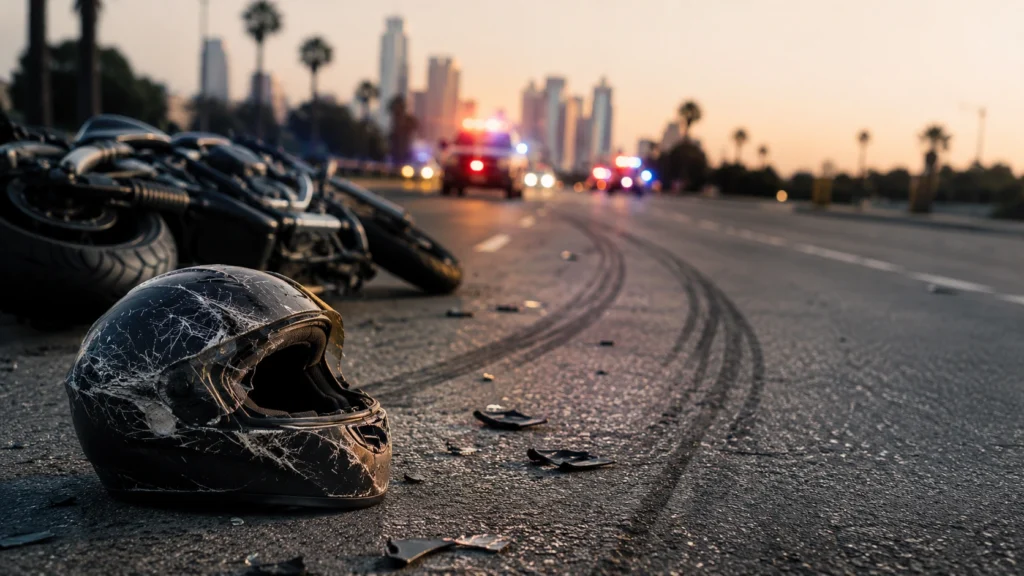
Motorcycle accident cases are different from other personal injury claims. The bias against riders is real. Insurance adjusters, juries, and even some judges start with the assumption that the rider was going too fast, weaving through traffic, or otherwise contributing to the crash. That assumption sits in the background of every case involving a motorcycle.
Overcoming that bias takes evidence, and the evidence that overcomes it is time-sensitive. What happens in the first 30 days after a motorcycle crash often determines whether the case can be won at all. This article walks through the timeline hour by hour and day by day.
The Bias Problem
Studies of jury behavior consistently show that motorcyclists face a credibility gap that other injury victims do not. When a rider says the car turned into their lane without signaling, some jurors default to skepticism. When a car driver says they never saw the motorcyclist, some jurors default to acceptance.
The bias is not universal. Los Angeles juries in particular tend to have more direct experience with motorcycles than juries in other regions. But it exists, and every good motorcycle accident lawyer builds the case around counteracting it.
The evidence that beats the bias is:
- Objective (traffic cameras, dashcam footage, physical evidence)
- Documentation-based (medical records, expert reports)
- Rider-conservative (no evidence of speeding, lane-splitting outside legal parameters, or aggressive riding)
Most of that evidence is time-sensitive.
Day 1: The Scene
The first hours after a motorcycle crash matter more than any other phase of the case.
Get medical care. Motorcycle crash injuries are almost always more serious than they first appear. Get transported by ambulance if the injury is anything above minor.
Preserve the bike. Do not let a tow yard scrap the motorcycle. It is evidence. Photograph it in detail before it is moved if possible. Track where it goes.
Preserve the helmet. If you were wearing one (California requires it under Vehicle Code 27803), the helmet is critical evidence. Impact patterns on the helmet corroborate what happened. Do not clean it, discard it, or send it in for warranty replacement.
Preserve the gear. Jacket, gloves, boots. Everything you were wearing tells part of the crash story.
Photograph the scene. The vehicle positions, skid marks, debris field, road surface conditions, signage, any road defects. If you cannot do this yourself because of injury, have a family member or witness do it as soon as possible.
Get witness information. Cars stopped after your crash. Pedestrians who saw it. Their names, phones, and license plate numbers if you can safely get them.
Days 2 Through 7: Medical Care and Documentation
The first week is about establishing the medical record and documenting the injuries clearly.
Follow through on every referral. The ER doctor said to see an orthopedist within a week. Do it, and do it within a week. Gaps in treatment become adjuster arguments later.
Document injuries visually. Take photos of bruising, road rash, and any visible injury. Bruising develops and fades over days. Photos taken at day one look different from photos taken at day five, and both matter.
Get the police report. Under California Vehicle Code 20012, anyone involved in a crash can request the report. Get yours. Look for errors that need to be corrected.
Identify additional witnesses. Sometimes witnesses come forward days after the crash. Check with businesses near the scene about security footage.
Send a preservation letter to the at-fault driver’s insurance company. This puts them on notice that the case will not go away and that they must preserve evidence.
Days 7 Through 14: The Evidence War
By the second week, the evidence picture starts to solidify. This is when the small window for perishable evidence closes.
Surveillance footage. Most business security systems overwrite footage every 30 to 60 days. Some overwrite every 7 to 14 days. If you have not identified and requested nearby footage by day 10, you are already at risk of losing it.
Vehicle inspections. Both vehicles should be inspected by an accident reconstruction expert if the case is anything more than minor. Damage patterns tell a specific story.
Medical documentation strengthening. Meet with your treating physicians and make sure the medical records clearly connect your injuries to the crash. Vague notes (“patient reports back pain”) are less useful than specific notes (“patient reports back pain since MVA on [date], with radiation into left leg”).
Initial insurance contact. Notify your own insurance company of the crash. Do not give a recorded statement to the at-fault driver’s insurance company.
Days 14 Through 30: Case Building
The last two weeks of the first month are about building the file that will support the case for months to come.
Expert consultation. For serious cases, retain accident reconstruction, medical, and vocational experts early. Their preliminary opinions guide the case strategy.
Medical care coordination. Some motorcycle crash injuries require multiple specialists: orthopedist, neurologist, physical therapist, pain management. Coordinating these is a project of its own.
Declaration of policy limits demand. Once initial injuries are documented, a request to the at-fault driver’s insurance company for a declaration of policy limits triggers formal disclosure of coverage amounts.
Investigation into additional defendants. Was the other driver on the job? Was the vehicle a rental? Was there a defective road condition? Any of these can add defendants and coverage to the case.
The Lane-Splitting Question
California is the only state where lane splitting is expressly legal. Vehicle Code section 21658.1 legalized the practice in 2016 and directed the CHP to issue safety guidelines.
Despite the law, some adjusters and defense lawyers still argue that lane splitting was inherently unsafe or contributed to the crash. Rider testimony and expert opinion can counteract this argument, but the fact that lane splitting was involved in a crash always adds complexity to the fault analysis.
If you were lane splitting at the time of the crash, document what you can about your speed and the traffic conditions. Speed differentials matter (a lane-splitting rider going 10 mph faster than surrounding traffic is generally seen differently than one going 30 mph faster).
Common Adjuster Tactics on Motorcycle Cases
Insurance adjusters use predictable arguments on motorcycle cases:
- “The rider was speeding” (used regardless of evidence)
- “The rider was lane splitting recklessly” (used regardless of speed differential)
- “The rider had inadequate protective gear” (used to argue injuries were exaggerated)
- “The rider was following too closely” (used in rear-end cases where the rider was in front)
- “Motorcycle injuries are inherently harder to prove causation” (used to argue medical connections were pre-existing)
Each of these can be pushed back on, but only with the evidence that was preserved in the first 30 days.
When to Bring a Lawyer In
The answer for motorcycle cases is: as soon as you are physically able to make the call. The first 30 days move fast. Evidence disappears. Witnesses become harder to reach. Insurance company investigators start building their file within hours of the crash.
At Ask Hamlet, our team handles motorcycle accident cases across Los Angeles. We move fast on evidence preservation, coordinate medical care documentation, and counter adjuster arguments that rely on outdated assumptions about riders. We also handle related car accident claims that share evidentiary features.
If you or a rider you love has been in a crash in the past 30 days, contact us for a free case review. The clock is running on evidence. We do not charge unless we win.