The question comes up in every initial consultation: “How long is this going to take?”
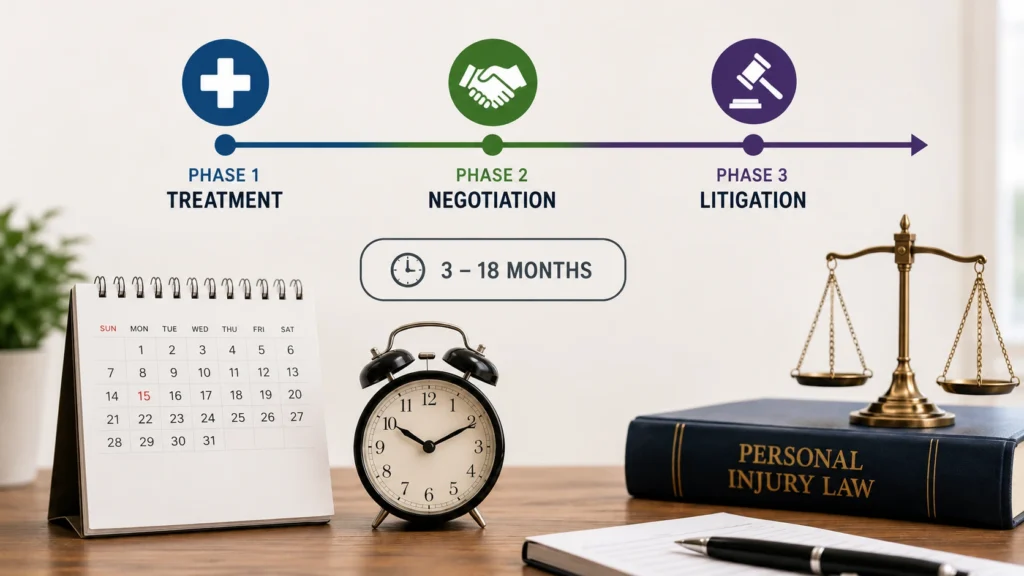
The honest answer is “it depends,” but that does not help anyone plan their life. A better answer breaks the question into phases and gives realistic timelines for each. Most personal injury cases in Los Angeles resolve in three to eighteen months. A meaningful share take longer, especially those that require litigation. A small fraction settle in under three months, usually because the injuries are minor or the policy limits are low.
This article walks through the phases of a typical Los Angeles personal injury case, the timelines for each, and the factors that speed things up or slow them down.
Phase One: Treatment and MMI
The first phase of any personal injury case is medical treatment. Until you reach a milestone called maximum medical improvement (MMI), valuing the case accurately is impossible.
MMI is the point at which your treatment has plateaued, either because you have fully recovered or because further treatment is not expected to produce significant additional improvement. For a minor soft-tissue injury, MMI can arrive in six to twelve weeks. For a herniated disc requiring physical therapy, epidural injections, and possible surgery, MMI can take six to eighteen months. For a traumatic brain injury or spinal cord injury, MMI can take years.
Settling before MMI is risky. You do not yet know whether you will need surgery, ongoing care, or accommodations. If the case settles before MMI and your condition worsens, the settlement closes the door on additional recovery.
This is the phase where the timeline is most variable. The rest of the case mostly depends on what happens here.
Phase Two: Pre-Litigation Negotiation
Once MMI is reached, your lawyer assembles the demand package: medical records, billing statements, lost wages documentation, photographs, witness statements, police reports, expert opinions if needed, and a written demand letter. This typically takes 30 to 60 days.
The demand goes to the at-fault driver’s insurance company. The company has 30 to 90 days to respond meaningfully. Most respond with a counter-offer well below the demand. From there, negotiation can take another 60 to 180 days, depending on the carrier and the case complexity.
For a typical car accident case with clear liability, soft-tissue injuries, and a cooperative carrier, pre-litigation resolution might happen four to nine months after MMI. For more complex cases, pre-litigation can stretch a year or more.
If the carrier refuses to make a reasonable offer, the case moves to litigation.
Phase Three: Litigation
Filing a lawsuit changes the timeline significantly. California law gives accident victims two years from the date of the crash to file a personal injury lawsuit under Code of Civil Procedure section 335.1. For claims against government entities, the deadlines are much shorter (a government claim form usually must be filed within six months under Government Code 911.2).
Once filed, the litigation timeline in LA Superior Court typically runs:
- Service and answer: 60 to 90 days
- Discovery: 6 to 12 months (written discovery, document production, depositions)
- Expert disclosures: 60 to 75 days before trial
- Mandatory settlement conference: 60 to 90 days before trial
- Trial: 18 to 36 months after filing
LA Superior Court has historically had one of the heavier civil dockets in California. Trial dates have moved further out in recent years. Most filed cases settle before trial, usually during the mandatory settlement conference or shortly after.
Total Realistic Timelines
Putting the phases together gives a realistic picture by case type.
Minor soft-tissue case, clear liability, cooperative carrier. Three to six months total. The case stays in pre-litigation and settles relatively quickly after MMI.
Moderate injury case (herniated disc, no surgery), clear liability. Eight to fifteen months total. The treatment phase is longer, which extends the total timeline even if litigation is not needed.
Serious injury case (surgery, permanent injury), clear liability. Twelve to twenty-four months total. MMI takes longer. Pre-litigation negotiation involves higher numbers and more pushback.
Disputed liability case (intersection crash, multi-vehicle). Eighteen to thirty-six months. Litigation is more likely because liability disputes rarely resolve cleanly in negotiation.
Catastrophic injury or wrongful death case. Eighteen months to four years. MMI determinations are complex, future medical care projections require expert testimony, and the cases often go to trial. Wrongful death claims involve additional procedural steps related to the decedent’s estate.
Truck or rideshare crash case. Twelve to thirty months. Multiple defendants, federal regulations, and higher policy limits add complexity.
What Speeds Things Up
Five factors compress the timeline.
Clear liability. Rear-end crashes, red-light runners, and DUI cases tend to resolve faster than disputed intersection crashes.
Cooperative insurance carriers. Some carriers settle reasonable demands quickly. Others negotiate hard on every dollar.
Low policy limits. When the at-fault driver carries minimum coverage and the case is clearly worth more than the policy, the carrier often tenders policy limits early.
Cooperative client. Clients who attend their medical appointments, communicate consistently, and follow their lawyer’s advice move cases faster than clients who do not.
Strong documentation. A well-documented case from day one (photos, witness contact info, prompt medical care) moves faster than a case that has to be reconstructed later.
What Slows Things Down
Five factors stretch the timeline.
Disputed liability. Any genuine fault dispute extends the case, sometimes substantially.
Multiple defendants. Each additional defendant adds time. Truck crashes and multi-vehicle crashes are typical examples.
Government defendants. Claims against cities, counties, or Caltrans add procedural steps and shorter deadlines.
Complex injuries. TBI, spinal cord injury, and chronic pain syndromes all take longer to reach MMI and require more expert involvement.
Carrier bad faith. A carrier that delays without cause, refuses to make reasonable offers, or denies clear claims can extend a case for years.
Why Faster Is Not Always Better
There is a relationship between case duration and case value. Quick settlements are often low settlements, especially for moderate to serious injuries.
The insurance company’s offer at month two will almost never reflect the full case value. The offer at month eight, after MMI is reached and the demand is documented, will usually be substantially higher. Pushing for speed often costs money.
This does not mean every case should take 18 months. It means clients should understand that the timeline is being driven by the case itself, not by lawyer inefficiency. A good personal injury attorney keeps clients informed about why the case is taking as long as it is.
How to Plan Your Life Around the Case
Three practical recommendations:
Plan for at least nine months. If your case settles faster, treat it as a bonus.
Continue your medical treatment. Settlement timing should follow medical timing, not the other way around.
Communicate with your lawyer monthly. Know where your case stands. Ask for written status updates if needed.
At Ask Hamlet, we set realistic expectations with every client about how long their case is likely to take. The timeline depends on the injury, the liability picture, the carrier, and whether litigation is necessary.
Time is only half the question. The other half is cost, and we compare both paths in our look at hiring a lawyer against handling the claim yourself.
If you want a candid estimate of how long your case might take and what factors apply to your situation, contact us for a free consultation. There is no obligation. We do not charge unless we win.