Trucks move differently than cars. They take longer to stop, swing wider through turns, sit higher off the road, and generate more force in a collision. When a passenger vehicle gets hit by an 80,000-pound tractor-trailer, the physics rarely favor the smaller vehicle.
Los Angeles County is the busiest goods movement region in the United States. The ports of Los Angeles and Long Beach are the largest in the Western Hemisphere by cargo volume. The corridors that carry that freight, from the ports to the warehouses and back out across the country, are also the corridors where most commercial truck crashes happen. Knowing where those corridors run helps you drive defensively. If you have already been hit by a truck, knowing the legal landscape helps you build a stronger case.
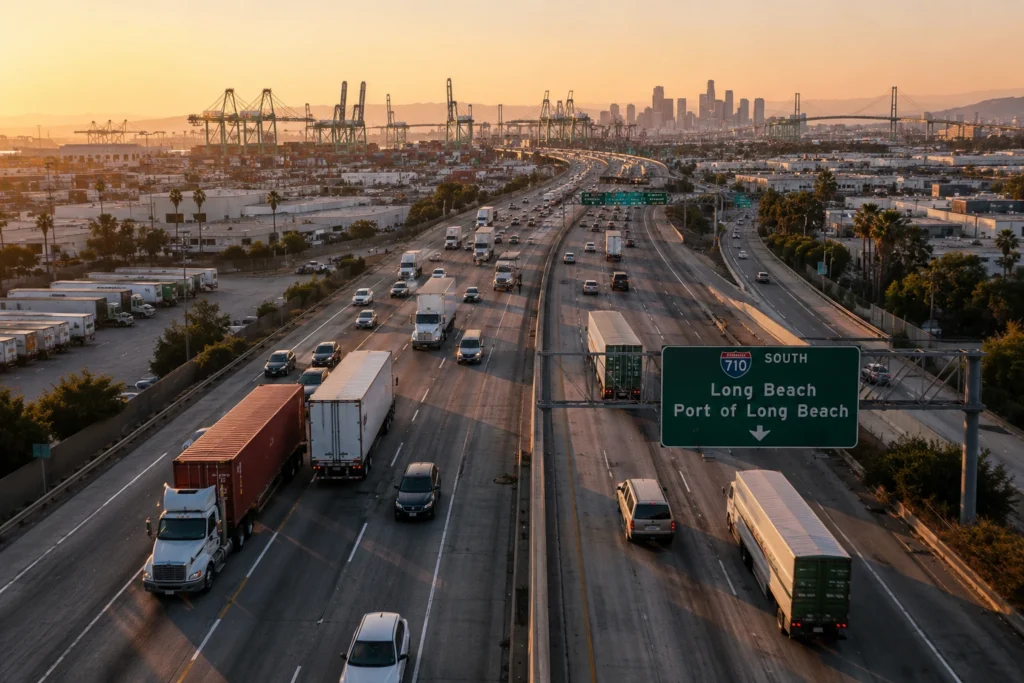
The Port Corridor: I-710 South
The 710 freeway carries more truck traffic than almost any highway in the country. The corridor runs from the Port of Long Beach north to the I-5 interchange in East LA, passing through Long Beach, Compton, Lynwood, South Gate, and Bell Gardens. Truck volumes regularly exceed 40,000 commercial vehicles per day on the southern portion.
What makes this corridor particularly dangerous:
- Aging infrastructure with limited shoulder space
- High commercial truck density mixed with passenger vehicles
- Frequent merging and lane changes near port entry points
- Air quality and visibility issues from concentrated diesel exhaust
- Speed differentials between loaded trucks (slower on grades) and passenger vehicles
A 710 truck crash is rarely a simple case. The truck driver, the trucking company, the cargo owner, the broker who arranged the shipment, and the maintenance contractor may all bear partial responsibility.
The Grapevine and the I-5
Interstate 5 is California’s primary north-south freight artery. The stretch known as the Grapevine, running from the southern San Joaquin Valley over the Tejon Pass into northern LA County, is one of the most challenging segments for commercial drivers in the country.
The Grapevine combines steep grades, sharp curves, and weather variability. Trucks descending the southbound side at over five percent grade frequently overheat brakes. Trucks ascending the northbound side struggle to maintain highway speed, creating dangerous speed differentials with passenger vehicles.
Once trucks clear the Grapevine and enter LA County, the I-5 continues through Sylmar, Sun Valley, Burbank, and Glendale before splitting toward the ports. Each of these segments sees regular commercial truck crashes, often involving multiple vehicles.
I-110 South and the Cargo Routes
Interstate 110 South runs parallel to I-710 as a secondary port corridor. The route serves trucks moving between the Port of Los Angeles and inland warehouses, plus the cargo facilities at LAX.
I-110 has its own pattern of crashes: shorter trip lengths than the 710, more local truck traffic (delivery, drayage), more transitions between freight and passenger traffic at exit ramps. The corridor through Carson, Wilmington, and into South LA sees a steady stream of commercial vehicle incidents.
I-405 and the Air Cargo Routes
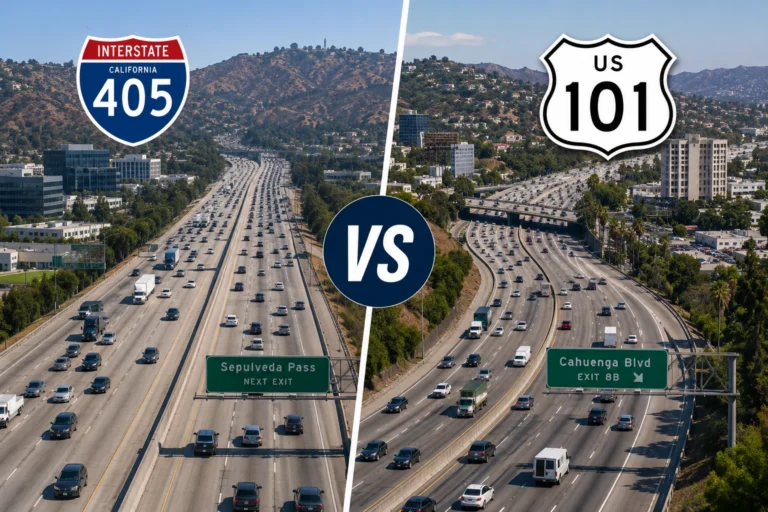
The 405 freeway is not primarily a freight corridor, but the segment near LAX carries significant air cargo traffic. Trucks moving freight between LAX and warehouses in the South Bay and El Segundo use the 405 corridor heavily.
Commercial vehicle crashes on the 405 tend to be smaller in scale than the 710 incidents (lower truck volumes, smaller vehicles) but more disruptive because of the freeway’s overall congestion.
I-10 East and the Inland Logistics Flow
Interstate 10 East carries freight from the LA region toward the warehouses of the Inland Empire. The corridor through East LA, Monterey Park, El Monte, and West Covina sees high commercial truck volumes, especially during midday and overnight hours.
Inland-bound truck crashes often involve specialized cargo: hazardous materials, oversized loads, refrigerated trucks. These add complications to any resulting claim because they bring additional regulatory frameworks (DOT hazmat rules, oversize permits) into the analysis.
Why Truck Crashes Are Legally Different
Commercial truck crashes differ from passenger car crashes in five important ways.
Federal regulations apply. The Federal Motor Carrier Safety Administration (FMCSA) regulates commercial trucking. Hours of service rules limit how long drivers can be on duty. Drug and alcohol testing requirements apply differently than for passenger drivers. Maintenance and inspection records must be kept.
Multiple defendants are common. The driver, the trucking company, the truck’s owner (sometimes different from the company), the shipper, the broker, and the maintenance contractor can all be defendants. Each may have different insurance coverage.
Higher policy limits. Commercial trucks usually carry far more insurance than passenger vehicles. Federal minimums for interstate trucking are $750,000 for general freight and higher for hazardous materials. Many carriers carry $1 million or more in coverage.
Evidence preservation is critical. Electronic logging devices (ELDs), dashboard cameras, GPS data, and maintenance records all matter. They can also disappear quickly if the trucking company is not put on notice to preserve them.
Investigation timeline is fast. Trucking companies often have rapid-response investigation teams that arrive at crash scenes within hours. They take photos, interview witnesses, and start building a defense before the victim has even left the hospital.
What to Do If You Are Hit by a Truck in LA
Six steps make a real difference.
Get medical care immediately. Truck crash injuries are often more serious than they first appear. Get evaluated at a hospital, not just a clinic.
Photograph everything you can. The truck (including USDOT number and company name), the trailer, your vehicle, the scene, any debris.
Get witness contact information. Truck crash witnesses are often other drivers who saw it happen and pulled over.
Request the police report. Truck crashes usually generate detailed CHP reports.
Send a preservation letter. The trucking company needs to be put on notice to preserve ELD data, dashcam footage, GPS records, and driver logs. A delay of even a few weeks can result in data being overwritten.
Talk to a lawyer who handles trucking cases. Truck accident cases are more complex than standard car accident cases. The investigation and litigation timelines are different. The defense lawyers are usually specialists. The case value is often higher.
The Local Knowledge Advantage
LA-based personal injury lawyers who handle trucking cases have seen the patterns play out on the 710, the 5, the 110, the 405, and the 10. They know which carriers operate which routes. They know which CHP units handle commercial enforcement in which areas. They know which medical providers specialize in the kinds of injuries truck crashes produce.
At Ask Hamlet, our team handles truck accident cases across Los Angeles, including crashes on the major freight corridors. We move fast on evidence preservation and we have direct experience with the federal regulations that apply to commercial drivers.
Trucks are one slice of the picture. For the wider view across the city, see our car accident statistics by Los Angeles neighborhood.
If you have been hit by a truck in LA, contact us for a free case review. The clock on evidence preservation is already running. You pay nothing unless we win.